Crochet Hook Sizes and Types: How to Choose the Right Hook
Use this crochet hook size chart to compare mm and US labels, match hook and yarn, understand hook types, and adjust your gauge for the fabric you want.

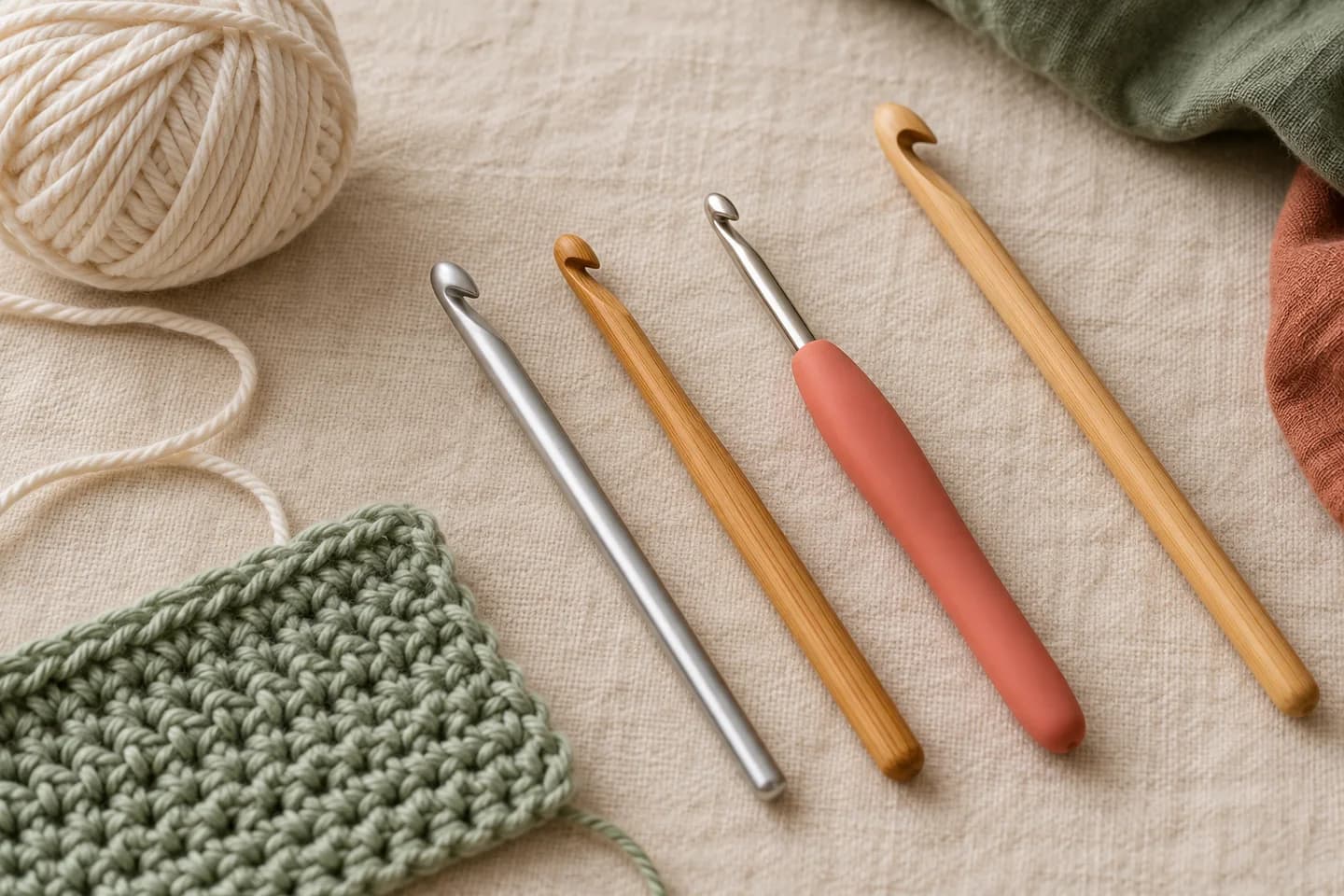
A crochet hook is a small tool with a surprisingly large effect on your fabric. The size changes the loops you form; the head and surface change how the yarn travels; and the handle changes how the tool feels in your hand. This guide explains what those differences mean so you can select a useful hook without buying a whole set first.
Quick answer: If you have a pattern, start with its stated hook size in millimeters (mm). Use the specified yarn or a suitable substitute, make a gauge swatch in the pattern stitch, and adjust the hook until the measured fabric works. If you have yarn but no pattern, the yarn label gives a starting hook range. Neither a letter on the hook nor a yarn label can guarantee the finished fabric.
For a first-hook shopping list that also covers yarn color, fiber, and supplies, use our beginner hooks and yarn buying guide. This page is the hook-only reference to return to when you need to decode a size, change fabric density, or choose a different style of hook.
The five parts of a crochet hook
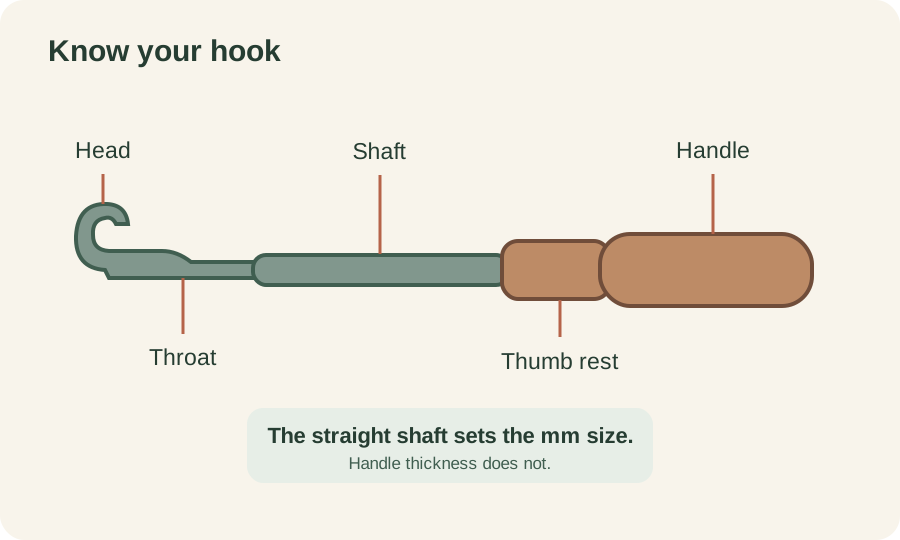
On a phone, open the hook anatomy diagram at full size.
The same five areas appear on most regular hooks, even when the overall shape changes:
| Part | What it does | What to notice |
|---|---|---|
| Head or tip | Enters a stitch and carries the working yarn through | A very sharp point may split loose yarn; a blunt one may be hard to insert in tight stitches. |
| Throat | Recess below the head that holds the yarn briefly | A shallow or deep throat can change how easily the yarn stays on or slips off. |
| Shaft | Straight section where the working loop rests | Its diameter is the hook's mm size. Let new loops reach this section instead of tightening them around the narrow neck. |
| Thumb rest or grip | Place where fingers stabilize the hook | It may be flat, shaped, or covered by a larger handle. |
| Handle | Section held in the hand | Its thickness affects comfort, not the stated hook size. |
The Crochet.com hook anatomy guide illustrates the head, throat, shaft, grip, and handle. Look at the shaft before reading a size chart: the fat ergonomic grip is not an 8 mm hook just because it is 8 mm wide.
Crochet hook sizes: read millimeters first
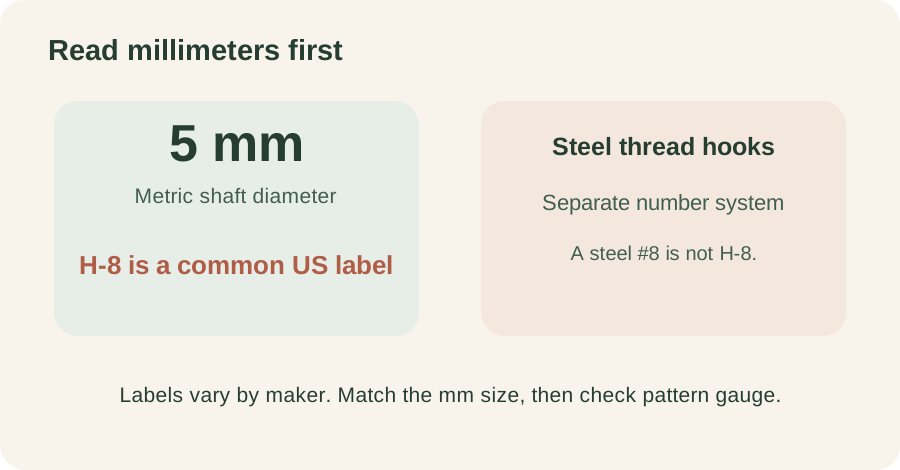
On a phone, open the metric size diagram at full size.
Most modern regular hooks show a metric size and sometimes a US letter or number. 5 mm describes the intended shaft diameter. H-8 is a common US label for that size. The Craft Yarn Council's hook chart warns that letters and numbers can vary among manufacturers, so compare the millimeter marking when following a pattern or replacing a hook.
This quick reference selects common regular-hook entries from that chart. It is not a chart for steel thread hooks, and it does not mean every maker uses exactly the same US label.
| Metric size | Common US label in the Craft Yarn Council chart |
|---|---|
| 2.25 mm | B-1 |
| 2.75 mm | C-2 |
| 3.25 mm | D-3 |
| 3.5 mm | E-4 |
| 3.75 mm | F-5 |
| 4 mm | G-6 |
| 4.5 mm | 7 |
| 5 mm | H-8 |
| 5.5 mm | I-9 |
| 6 mm | J-10 |
| 6.5 mm | K-10½ |
| 8 mm | L-11 |
| 9 mm | M/N-13 |
| 10 mm | N/P-15 |
Some intermediate sizes, such as 4.25 mm or 5.25 mm, appear in the full chart. A size may be sold without a familiar US letter. If an older pattern gives only a letter, use the chart to choose a starting metric size, then check gauge. Do not force a modern letter-to-mm conversion to stand in for a swatch.
An older UK pattern may use a numbered system that does not follow modern US letters. Check the pattern's own key or the original publisher's conversion before buying a hook; if a metric size is given anywhere, use that number as your starting point. The stitch names in UK patterns can differ from US stitch names too, which is a separate issue from hook size. Our pattern abbreviation guide helps you check the terminology.
Steel thread hooks use a different numbering system. Within a steel-hook range, a higher number generally means a smaller hook. A steel hook numbered 8 is not the same tool as a regular H-8. The Craft Yarn Council steel-hook reference also shows that steel numbering varies, so check millimeters and the actual thread pattern rather than relying on the number alone.
What size hook goes with a yarn weight?
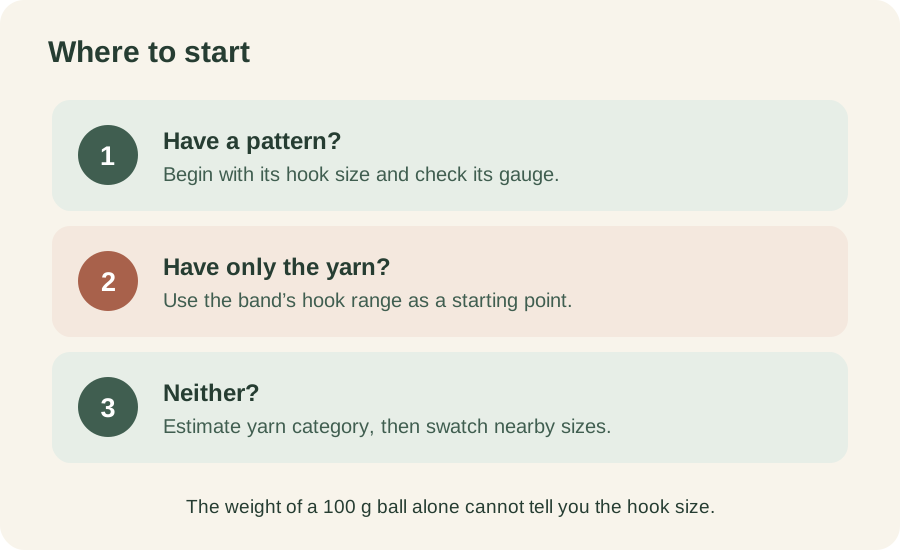
On a phone, open the hook-choice diagram at full size.
The category number on a yarn band describes yarn thickness, not the weight of the ball. The Craft Yarn Council yarn-weight system offers these broad starting ranges for regular crochet hooks:
| Yarn category | Common name | Suggested starting hook range |
|---|---|---|
| 1 | Super fine / fingering | 2.25–3.5 mm |
| 2 | Fine / sport | 3.5–4.5 mm |
| 3 | Light / DK | 4.5–5.5 mm |
| 4 | Medium / worsted | 5.5–6.5 mm |
| 5 | Bulky | 6.5–9 mm |
| 6 | Super bulky | 9–15 mm |
| 7 | Jumbo | 15 mm and larger |
Lace/category 0 varies too much by fabric to give one useful regular-hook range here; it may call for a tiny steel hook or a much larger regular hook for open lace. Follow the lace pattern and test the fabric. These category ranges are guidelines, not rules or yarn-substitution guarantees. A particular medium yarn and pattern may reasonably specify a 5 mm hook even though the broad category-4 table begins at 5.5 mm. The pattern's gauge and the yarn's own label are more relevant to that project than the category table alone.
The label 100 g tells you how much a ball weighs, not how thick its strand is. Two 100 g balls can have very different lengths and yarn categories, so they may need different hooks. Read the yarn category and suggested hook range on the band; for a pattern, check gauge with the exact yarn you plan to use. Cotton yarn also comes in many thicknesses, so there is no single hook size for "cotton yarn."
Three starting points, in order
- A pattern with gauge: Start with the yarn and metric hook stated in that pattern. Make the requested stitch pattern and measure the washed or relaxed swatch as directed.
- Yarn with no pattern: Check the hook icon or written size range on the yarn label. Make a small swatch to decide whether you want firm, balanced, or open fabric.
- Neither pattern nor label: Identify the yarn as closely as you can, choose a plausible starting hook, and test a few neighboring sizes. Avoid promising a finished measurement until you have a swatch.
If you need help reading yarn weight, yardage, and care information together, the beginner buying guide walks through a yarn band step by step.
How hook size changes your fabric
With the same yarn and stitch, a larger hook usually makes larger loops and a more open fabric; a smaller hook usually makes smaller loops and a denser fabric. Your personal tension, hook shape, and the yarn still matter, so treat that relationship as a direction to test rather than a promise about exact measurements.
| Your project needs | What to try | What to inspect before continuing |
|---|---|---|
| A stuffed amigurumi that hides filling | Try a smaller hook than you would for a loose scarf using the same yarn | Bend the swatch slightly with stuffing behind it; look for gaps and check whether you can still insert the hook comfortably. |
| A drapey garment or shawl | Try a larger hook or a different stitch/yarn if the fabric feels board-like | Wash or relax the sample and check drape and the pattern's stitch and row gauge. |
| A bag or other structured accessory | Aim for a firm fabric suited to the bag's construction | Check stretch, stitch gaps, handle attachment, and whether lining is needed; a small hook alone does not make a bag load-bearing. |
| A pattern with required finished measurements | Adjust until your swatch approaches its stated gauge | Measure stitches and rows over the area and stitch specified by the pattern. |
For more detail about stuffed fabric, see our amigurumi yarn and hook guide. For fitted projects, the garment sizing guide explains why gauge matters beyond the hook printed on the pattern.
A gauge example that prevents a common mistake
Suppose a pattern asks for 16 stitches across 10 cm, and your washed swatch has 18 stitches across 10 cm in the same stitch. You fit more stitches into that width, so your stitches are smaller. Try a larger hook and swatch again. If you count 14 stitches instead, your stitches are larger; try a smaller hook. These counts are a teaching example, not gauge data for a Crochet Nook pattern.
Measure away from the edges of a swatch larger than the measurement window. Check row gauge too: matching stitch width while rows are too short can still change garment length or shaping. Changing hook size may not fix both directions; tension, stitch technique, yarn substitution, and pattern instructions may need review. The Craft Yarn Council gives the same stitch-count adjustment direction in its hook-size guidance.
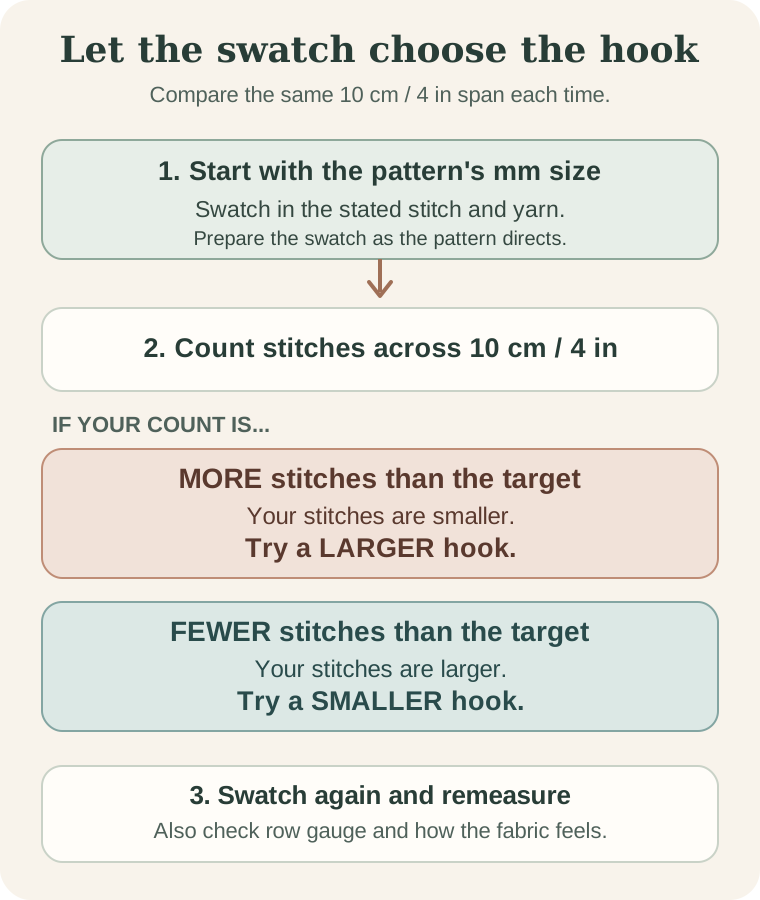
On a phone, open the gauge decision map at full size if the labels are too small.
Types of crochet hooks and when to use them
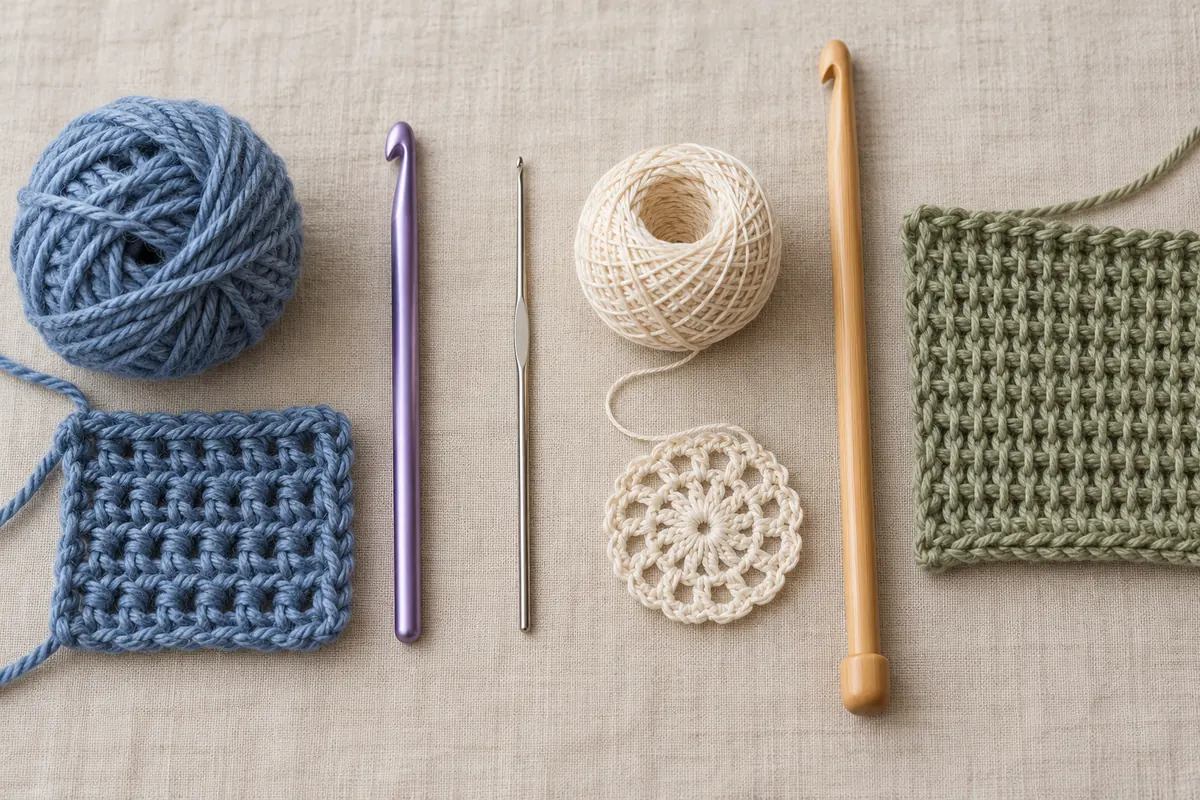
| Hook type | Recognize it by | Use it when |
|---|---|---|
| Regular crochet hook | One hooked head and a short shaft for one live loop at a time | Working most rows, rounds, motifs, and ordinary patterns. |
| Steel thread hook | Fine, strong metal hook with its own size-numbering system | Working crochet thread or fine lace when the pattern calls for one. |
| Tunisian crochet hook | Long straight shaft or a cable that can hold many live loops | Working a Tunisian forward pass across a wider row. |
| Double-ended hook | Hooked head on both ends | Following a technique that works from either end, often with two yarns. It is not interchangeable with every single-ended Tunisian pattern. |
| Interchangeable or cabled Tunisian hook | Short hook tip connected to a cable and stopper | Holding a larger number of live loops without crowding a long rigid shaft. |
The Tunisian crochet beginner lesson shows why width matters: its sample has 21 loops on the hook at once. A regular hook may hold a tiny test, but it is not a good substitute for a wide Tunisian blanket. Do not buy a specialty hook merely because a regular pattern is worked in rows; check that the instructions actually say Tunisian or require multiple live loops.
Inline versus tapered heads
Two regular hooks with the same metric diameter may feel different. An inline design commonly has a more aligned head and shaft; a tapered design narrows toward the head. The shape of the point and throat varies even within these descriptions. One may help you catch your yarn cleanly while another glides through a dense stitch more easily. These are handling preferences, not a rule that one design always makes better gauge or prevents splitting. The Crochet.com hook guide shows both shapes.
If a hook repeatedly splits yarn, first check whether you are entering between the right loops and whether the yarn itself has a loose twist. Then compare another head shape in the same mm size before changing both hook and yarn at once.
Metal, bamboo, wood, plastic, and soft grips
The material affects glide and feel, while the shaft's marked mm size describes its intended diameter. Smooth metal often lets yarn move quickly. Bamboo or wood may give more surface grip. Plastic can be light, particularly in large sizes, but check it for flex or rough seams. A soft-grip or ergonomic handle changes the section your fingers hold; it does not automatically change the hook tip or make a particular size suitable for your yarn.
There is no universally best material. Try the same yarn with two hooks of the same mm size, if available, and notice whether the yarn snags, slips away, or makes you squeeze the handle. A smooth finish and a shape you can use comfortably are more useful than a large, expensive set you have not tested. For an initial purchase, return to the one-hook buying checklist.
Grip, comfort, and choosing a handle
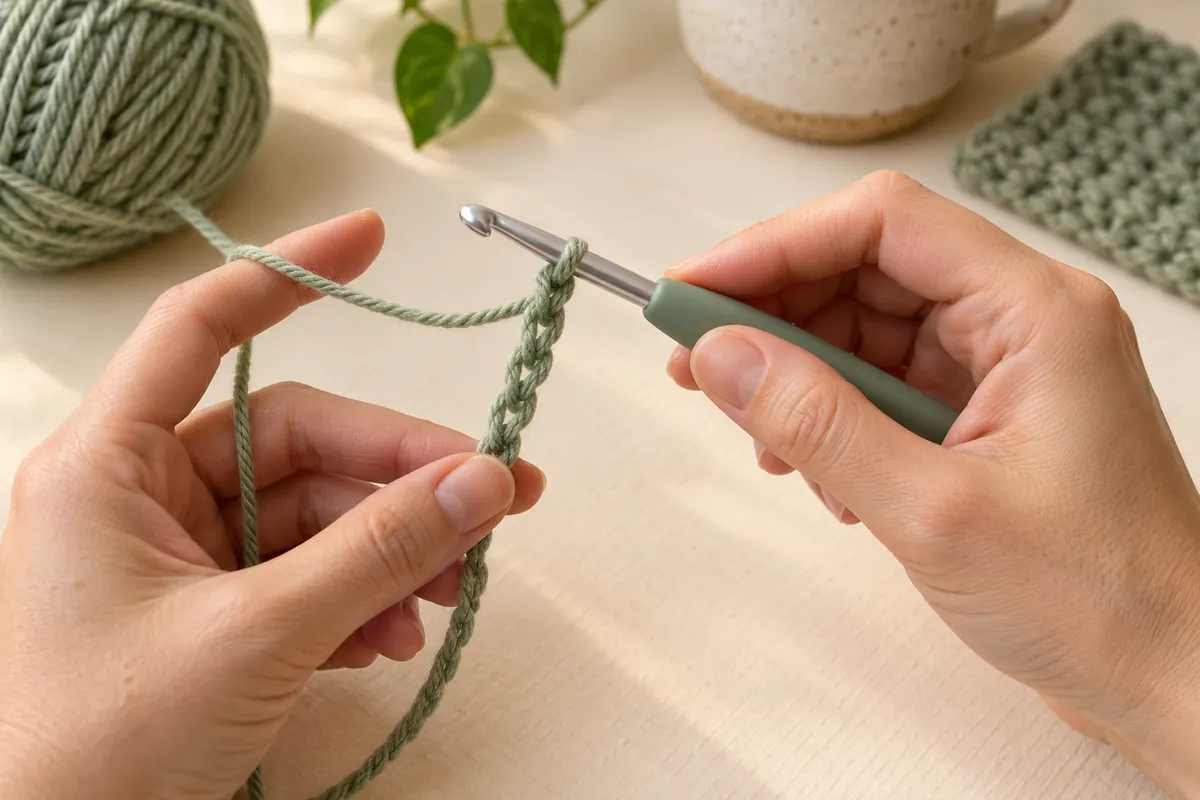
Many crocheters hold a hook roughly like a pencil or like a table knife. Neither is mandatory. Let the hand position and handle support a relaxed motion rather than forcing your fingers into a named grip. Check that you have enough exposed shaft to form your stitches; an oversized handle placed too near the head may feel awkward for taller stitches or multiple loops.
When comparing handles, make a few minutes of chains and single crochet with the same yarn, then notice whether you are clenching your hand, rotating your wrist sharply, or fighting the hook's surface. Pause if you develop pain or numbness. A handle may feel more comfortable to some people, but it is not a medical treatment or a substitute for professional advice about persistent symptoms.
Tips & troubleshooting
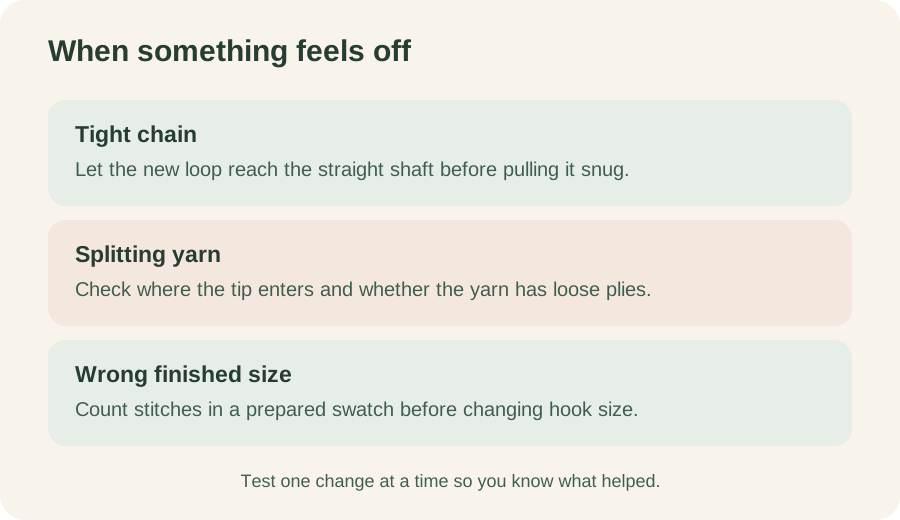
On a phone, open the troubleshooting diagram at full size.
When the hook seems wrong
| Problem | First check | Sensible next test |
|---|---|---|
| The starting chain is hard to enter | New loops may have been tightened around the throat instead of sized on the shaft. | Make the chain more evenly, or test a slightly larger hook for the foundation only. |
| The hook splits the yarn | The tip may catch one ply, or the strand may be loosely twisted. | Re-enter carefully; compare another head shape at the same mm size. |
| The hook catches on every stitch | Look for a rough edge, damaged coating, or a burr at the tip. | Stop using a damaged hook and test a smooth one of the same size. |
| The stuffed fabric shows filling | The fabric may be too open or overstuffed. | Compare a smaller-hook swatch and a less-stuffed sample before changing a whole pattern. |
| Your garment is too large despite following counts | Counted stitches do not guarantee the stated gauge. | Measure a properly prepared swatch; if it has fewer stitches per 10 cm than required, test a smaller hook. |
| An older hook has no readable size | The letter may have worn off or used another maker's convention. | Use a crochet-hook gauge to check the straight shaft, then swatch. Do not measure the handle or hooked tip. |
Changing tools halfway through a large project can show in the fabric even if the stamped mm size matches. Keep the same hook when possible, and record its maker and size beside your yarn and gauge notes. If you change tools, compare a short section before continuing.
Keep hook tips protected from bends or rough contact in a case, and set aside any hook with a burr that snags yarn. If a printed size wears away, label the case slot or make a note after checking the straight shaft with a hook gauge. Clean a hook according to its material and maker's instructions; do not soak a wooden handle simply because a metal tip can be wiped clean.
Frequently Asked Questions
Is 5 mm a good first crochet hook?
It can be a comfortable practice starting point with smooth, visible medium-weight yarn, which is why our first crochet lesson uses it. Check the chosen yarn label. A pattern with specified yarn and gauge takes priority over a general beginner suggestion.
Does a bigger hook always use more yarn?
Not in a simple, dependable way. A larger hook changes stitch size and may change the number of stitches or rows needed for the same finished dimensions. Yarn amount also depends on stitch pattern, tension, and design. Make and weigh a representative swatch if a project needs a defensible estimate.
Are a 5 mm hook and an H-8 hook the same?
They match in the Craft Yarn Council regular-hook chart, but US labels can differ by maker. Read the millimeter marking on your actual hook and make a gauge swatch when size matters.
Can I use a regular hook for Tunisian crochet?
A few loops for a very narrow practice test may fit. For a wider Tunisian row, use a long or cabled hook that can hold all live loops without bunching; read the specific pattern's requirements.
What if the yarn label and pattern recommend different sizes?
Start with the pattern's hook and the yarn it specifies, then swatch. The yarn-label range describes a broad use for the yarn; the designer may need denser or looser fabric. If you substitute yarn, swatch with your candidate hook and compare gauge and fabric behavior before committing.
What hook size should I use for a 100 g ball of yarn?
The ball's 100 g weight alone cannot answer this. Check the yarn's weight category and suggested hook range, or use the hook and gauge given in your pattern. A 100 g ball of fine yarn and a 100 g ball of bulky yarn call for different starting hooks.
Do I need every hook size in a set?
No. One suitable hook works for first practice. Add a size when a new pattern or a swatch shows you need it. A smooth, comfortable hook you actually use is more valuable than an unused collection.
Put the guide to work
Choose one project, note its yarn and hook size in mm, then make a small sample before buying several matching hooks or all the yarn. Start with the absolute beginner swatch, explore amigurumi fabric choices, or follow the Tunisian hook lesson if that is the tool you need next. The best hook is the one that helps you make the required fabric at a workable gauge while feeling comfortable in your hands.
Essential crochet guides
Maker notes
Questions or finished-project notes?
Share what helped, ask about a step, or leave a thoughtful note for the next maker.
Loading maker notes...