Tunisian Crochet for Beginners: Getting Started
Learn Tunisian crochet with a 21-stitch practice swatch: follow the forward and return passes, find the last edge stitch, and fix curling or lost loops.

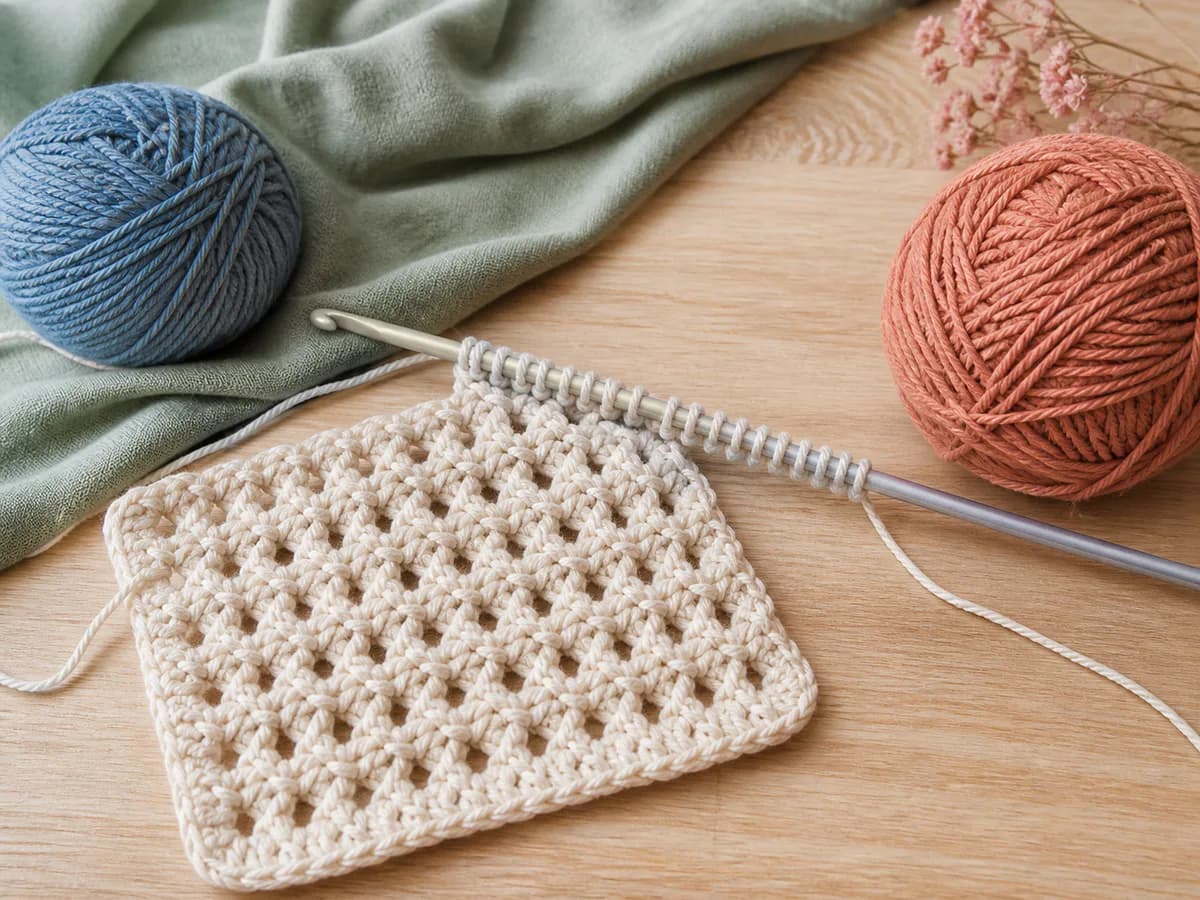
Tunisian crochet keeps the loops of a whole row on a long hook, then works them off again. In this lesson you will make one small 21-stitch Tunisian simple stitch swatch. You will know where to put the hook, how many loops to expect, and why the fabric may curl.
This is a written technique exercise reviewed against published instruction guides, not a claim that this exact swatch was physically made or measured. If chains and yarn overs are new to you, start with our absolute beginner crochet lesson.
Gather one hook and visible yarn
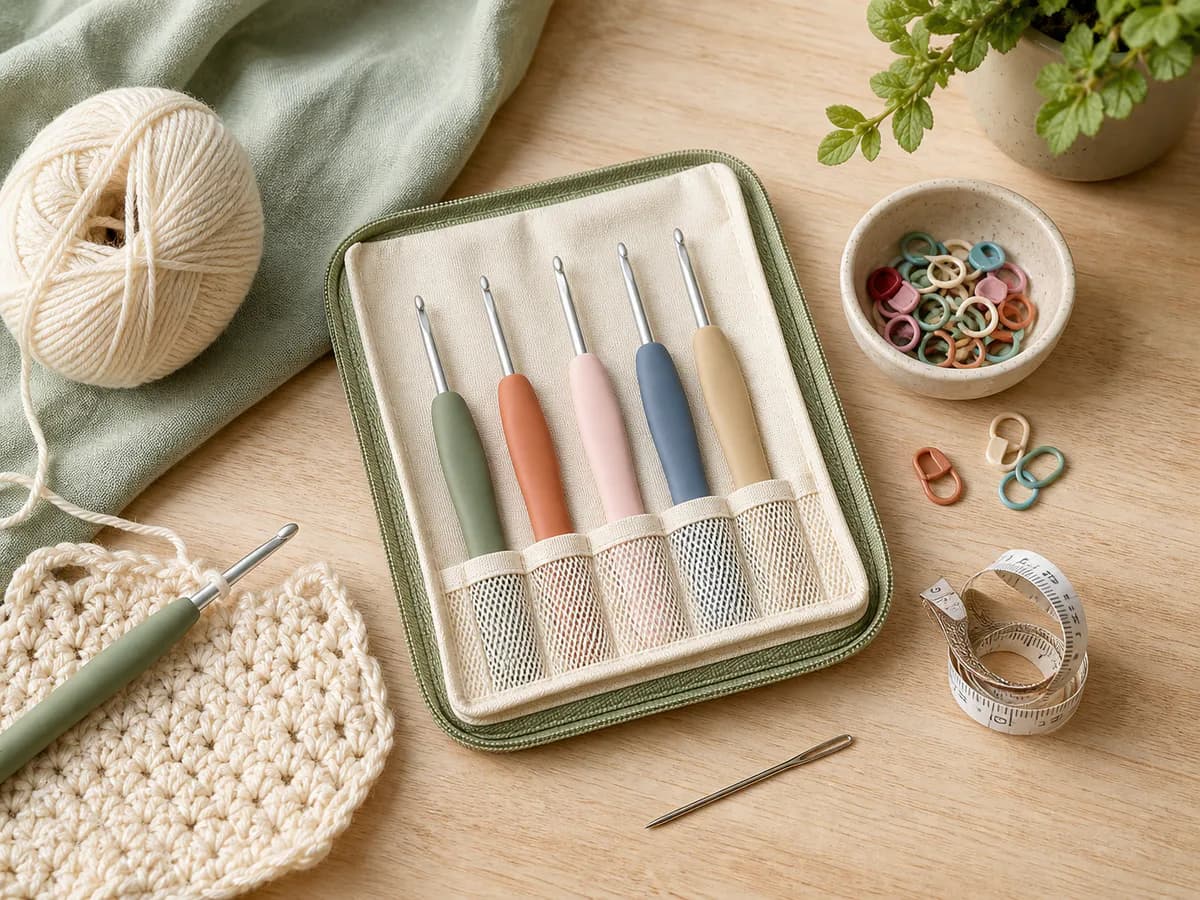
- One 6.5 mm Tunisian hook with a long shaft or cable that can hold 21 loops without crowding; use the size as a starting point, not a guaranteed gauge
- Smooth, light-colored worsted-weight yarn so you can see the vertical bars
- One removable stitch marker for the far edge, scissors, and a yarn needle
You do not need a second 5 mm crochet hook for this swatch. A regular hook may hold a very narrow test, but a longer Tunisian hook gives the loops room and keeps a wider project from bunching up. Choose a hook that can hold the planned width; a cable matters much more for a blanket than for this little exercise. Our beginner hook and yarn guide explains how to read yarn labels without buying a full set first.
Understand a Tunisian row before starting
The forward pass picks up loops and leaves them on the hook. The return pass works those loops back off. Together they make one row. Keep the front of the fabric facing you; do not turn it between passes. Right-handed crocheters normally pick up loops from right to left and return from left to right. Left-handed crocheters mirror those directions.
We use US terms: ch = chain, yo = yarn over, sl st = slip stitch, and Tss = Tunisian simple stitch. A front vertical bar is the upright strand nearest you on the face of the fabric. The working loop already on the hook counts toward the loop total; it is not a place to insert the hook again. Crochet.com's Tunisian overview illustrates the two-pass method with step photos.
Make the 21-stitch foundation row
- Make a slip knot and ch 21 loosely. The loop already on your hook is the first of the eventual 21 loops.
- Insert the hook into the second chain from the hook, yo, and pull up one loop. Leave it on the hook. The back bump gives a tidy lower edge, but using the usual top chain loop is also workable if the bumps are hard to see.
- Pull up one loop from each remaining chain, keeping all loops on the hook. You worked into 20 chains, so you should now have 21 loops, including the original working loop. Do not turn.
- For the return pass, yo and pull through one loop only. Then yo and pull through two loops; repeat that two-loop move 20 times until just one working loop remains. The first pull-through makes the side chain; it does not increase your 21-stitch width.
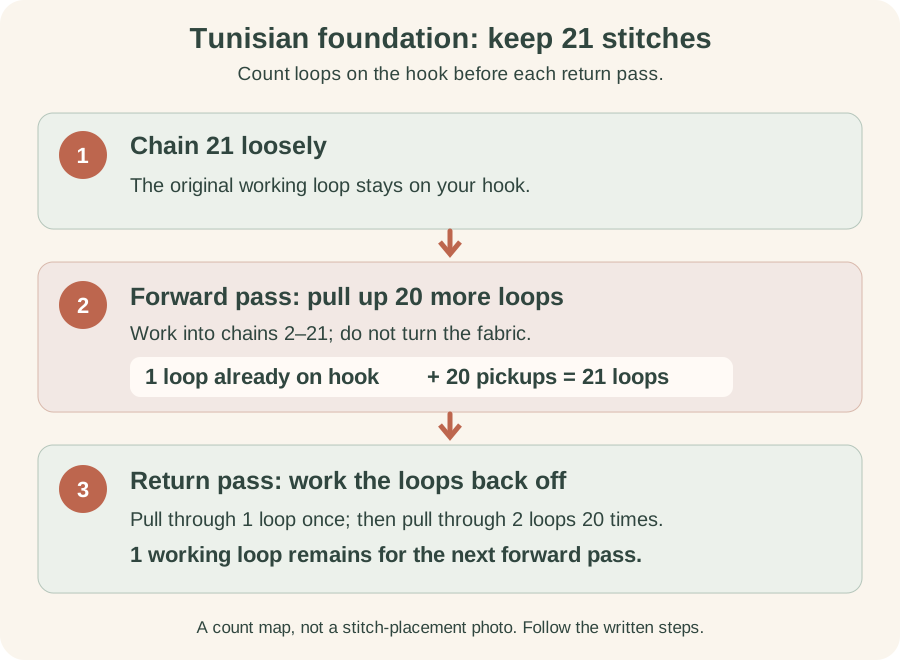
On a phone, open the count diagram at full size if the numbers are too small. This is a count map, not a picture of hook insertion. Yarnspirations' foundation-row photos show what the loops and vertical bars look like in actual fabric.
Work Tunisian simple stitch rows
After the foundation return pass, the one loop on your hook is already the first stitch of the new forward pass. Do not work into the vertical bar directly below that loop.
- Insert the hook from right to left behind the next front vertical bar, yo, and pull up a loop. Leave it on the hook.
- Repeat under each front vertical bar across. At the far edge, find the two strands of the last edge stitch and insert under both strands for the final pickup. Mark that far edge before your first row if it is difficult to spot. You should have 21 loops again: the starting loop and 20 pickups.
- Work the same return pass: yo through one loop, then yo through two loops 20 times until one loop remains. That completes one Tss row. Do not turn.
- Repeat these steps for about 15 Tss rows after the foundation row, or stop sooner when you can keep the 21-loop count consistently. Count the foundation separately so “15 rows” does not hide an extra or missing pass.
The Crochet.com simple-stitch photos show which front bar to use; its end-stitch guide shows the two far-edge strands. These source photos are more precise for hook placement than a decorative diagram.
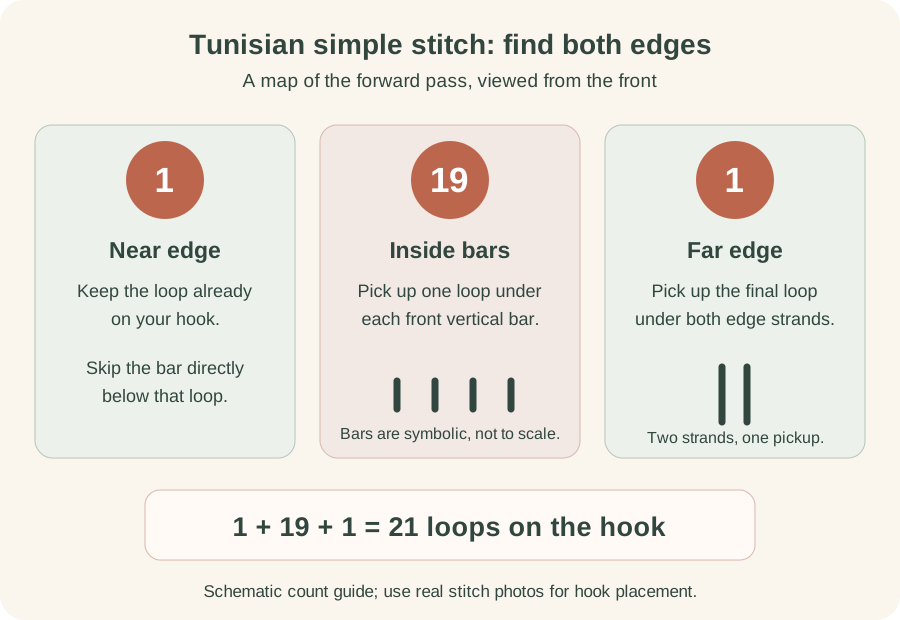
Open the edge diagram at full size when reading on a small screen.
Bind off without leaving loose vertical bars
With one loop on the hook after the final return pass, skip the first bar directly below it. Insert under the next front vertical bar, yo, and pull through the fabric and the loop on the hook in one motion, like a slip stitch. Continue across the front bars. At the far edge, go under both strands of the last edge stitch and make the same slip stitch. Fasten off and weave in the tail without tugging the edge tight. The top should now have a finished chain-like line rather than open upright bars.
Tips & troubleshooting
I have 20 loops instead of 21
Check the far edge first: its last stitch can hide against the side. Pinch the edge and look for both strands, then pick up the final loop. If you missed a chain on the foundation row, undo that row and count 20 pickups plus the loop that was already on your hook.
I have 22 loops or my edge grows
Do not work into the first vertical bar immediately below the working loop. That loop already represents the first stitch. Also check that you did not pick up two loops from the same far-edge stitch. Count the loops before beginning the return pass; correcting a pickup now is easier than finding the extra stitch several rows later.
The return pass is tight or the hook will not slide
Do not pull the first one-loop pass or each two-loop pass snug against the hook throat. Let the loops sit on the full-sized shaft or cable, and try a larger Tunisian hook if the fabric stays stiff. Keep one variable at a time while comparing swatches; the yarn-label hook size is a starting point for ordinary crochet, not a Tunisian gauge requirement.
The swatch rolls toward me
Tunisian simple stitch often curls because of its fabric structure. A larger hook and a relaxed return pass can reduce the curl; wet-block a washable practice swatch according to its yarn label and let it dry flat. Blocking may help but does not guarantee a perfectly flat edge. For a finished project, choose a suitable border or a less curl-prone stitch rather than promising that one hook change will solve it.
The side edges lean or look uneven
Keep all 21 loops on the hook at the end of every forward pass. Missing the two-strand far-edge stitch narrows one side; working the starting bar again widens the other. If the count is right but one edge is tight, compare your first pull-through-one with the rest of the return pass before changing hook size.
Frequently Asked Questions
Do I turn the work like ordinary crochet?
No. For this flat Tunisian exercise, keep the same side facing you while the forward pass builds loops and the return pass works them off. Both passes count as one row.
Why does chain 21 produce 21 loops if I skip the first chain?
The original working loop stays on the hook. You pick up one new loop in each of the other 20 chains: 1 + 20 = 21. The skipped chain is the one nearest the hook, not an instruction to discard the working loop.
Can I use a different yarn or hook?
Yes. Choose a Tunisian hook that holds all the loops comfortably and adjust its size until the fabric moves without forcing the hook. A different yarn or tension changes the swatch's width, drape, and curl; no finished dimensions have been verified for this exercise.
Keep learning
Use our pattern-abbreviation guide if the short forms are unfamiliar, and the common crochet mistakes guide for general tension habits. When you are ready for a specific Tunisian project, follow that project's own gauge, stitch, and hook instructions rather than treating this swatch as a universal pattern.
Essential crochet guides
Maker notes
Questions or finished-project notes?
Share what helped, ask about a step, or leave a thoughtful note for the next maker.
Loading maker notes...