Common Crochet Mistakes and How to Fix Them
Fix common crochet problems including uneven edges, missed stitches, tight chains, curling fabric, and confusing counts with practical checks.

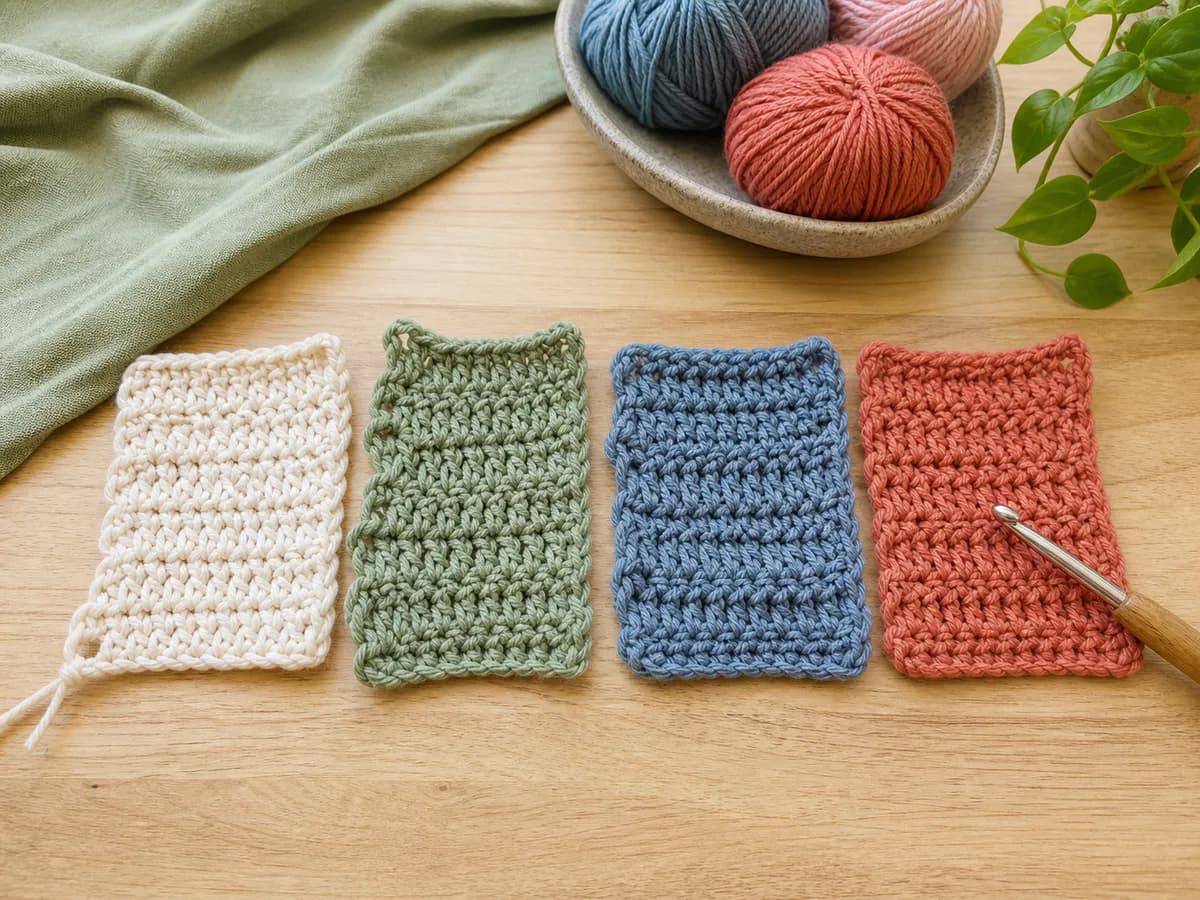
Crochet mistakes are easier to fix when you separate the symptom from its cause. A narrowing rectangle may have missing stitches; a tight first edge may have the correct count but a smaller foundation. Start with the checks below before changing your hook or undoing the whole project.
This guide uses US crochet terms and focuses on practice fabric. For a shaped pattern, follow its intended increases, decreases, and turning-chain convention rather than forcing every row to stay the same width.
Materials and supplies
- Your current project and its written instructions
- Two locking stitch markers in contrasting colors
- A hook, smooth light-colored practice yarn, and a tape measure
- A note of the expected stitch count for the row or round
Use the beginner hook and yarn buying guide if fuzzy yarn or a difficult grip is making stitches hard to see. Our crochet abbreviation guide explains ch, sc, hdc, dc, inc, and dec.
Find the symptom first
| What you notice | Check before changing anything | First correction to try |
|---|---|---|
| Each straight row gets shorter | Count the top V shapes, including the edge stitches | Mark the first and last actual stitch and locate the missing stitch |
| Each straight row gets wider | Look for two stitches in one place or an extra turning-chain stitch | Follow one turning-chain convention throughout |
| The foundation pulls inward | Compare its width with later rows and confirm the count | Remake a looser foundation while keeping the working rows unchanged |
| Stitches split as the hook enters | Look for separate yarn plies caught on the hook | Undo the split stitch and insert through the full intended loop |
| A circle cups or waves | Check whether the pattern intends a flat disk or a shaped bowl | Verify increases before changing the hook |
| Fabric width changes despite equal counts | Compare loop size and how freely yarn feeds from the ball | Restore a relaxed, repeatable tension |
Fix shrinking or growing rows
Lay the piece flat without stretching. Count stitches across the last correct row, then count the next row. The loop currently on your hook is not an extra completed stitch. A turning chain counts only when the instructions say it does.
For single crochet practice, mark the first and last sc immediately after making them. Move the markers upward as each new row is worked. A marker belongs in the top of the stitch you will work into next, not in a loose strand beside it.
A counted example you can follow
- Chain 21. Work sc in the second chain from the hook and in each remaining chain: 20 sc.
- Ch 1 and turn. This turning chain does not count as a stitch. Sc in the first sc and every sc across: 20 sc.
- Mark the first and twentieth stitch. Repeat row 2 for three more rows, counting every time.
- If you count 19, check the last stitch and the first stitch before assuming your tension caused the change. If you count 21, look for an extra stitch in the turning chain or a duplicated insertion.
For this unshaped example, every row stays at 20. If a mistake is several rows back, undo to that row and rebuild from the correct count. Adding a random stitch to compensate can leave a notch in the edge.
Loosen a tight foundation without changing the whole fabric
First confirm that the first row has the intended number of stitches. If it does, and only the starting edge draws inward, the chain may be tighter than the later rows. Try a slightly larger hook for the foundation only, then return to the working hook. Make another short sample before restarting a large project.
Keep each new chain loop on the full hook shaft while sizing it; repeatedly pulling the yarn tight around the narrow throat makes small chains. If you already know foundation single crochet, that is another option, but check how the replacement changes your pattern's starting instructions.
A short sample curling during its first rows does not automatically mean the chain is wrong. Let several rows develop, then compare the relaxed edges and counts. Some stitch textures curl naturally, so avoid treating all curling as the same problem.
Diagnose a circle that cups or waves
A flat circle depends on stitch height, tension, and the increase schedule. Cupping can come from too few increases or tight stitches; waves can come from too many increases or looser fabric. A bowl or toy head may intentionally cup, so first check what shape the pattern is asking for.
Count both the stitches consumed and the stitches produced by a repeat. For example, (2 sc, inc) repeated 6 times consumes 18 stitches and produces 24: each repeat works across three old stitches and makes four new ones. Check the previous round before altering the repeat.
If your counts match but the shape does not, make a separate small test with one variable changed. Do not remove arbitrary increases from a fitted or counted pattern; later instructions may rely on those exact totals. Check the designer's gauge and construction notes first.
Reduce gaps, split stitches, and uneven tension
For ordinary practice fabric, slight gaps are not necessarily an error. For stuffed crochet, the fabric must contain the filling. Do not pack in more stuffing to hide an uneven shape: it can spread the stitches further. A smaller hook may create denser fabric, but it also changes the finished dimensions.
If the hook catches only part of the yarn strand, undo that stitch and remake it. Repeated splitting can come from the insertion angle, yarn construction, or the hook tip. Try changing the angle before buying another tool. Stop pulling when a snag occurs so it does not tighten into the fabric.
For tension changes, check whether the yarn ball has become tangled or trapped under your arm. Let loops slide onto the shaft instead of tightening every stitch afterward. Pause, release your grip, and compare the width of recent rows with earlier ones. Keep the stitch count constant during this comparison.
Tips & troubleshooting
Know when to undo a section
Undo work when the count or structure prevents the next step from fitting, or when a split strand compromises a stitch. A small visual irregularity in a practice square can stay as a learning note. A missing structural stitch in a garment seam or attachment deserves correction before finishing.
Joined seams and color changes need their own rules
A leaning seam is not always a counting error because crochet stitches have a natural slant. Check whether the pattern joins, turns, or works continuously. Do not switch methods midway simply to hide the seam: color placement and round beginnings can change. Mark the start and follow the stated method consistently.
Keep a short correction record
Write the row number, expected count, actual count, and one adjustment you made. If the next attempt improves, you know what helped. This is more useful than changing yarn, hook, and stitch placement at the same time.
Frequently Asked Questions
Why are my edges uneven when the count is correct?
Check turning-chain placement, the height of edge stitches, and tension. Equal counts rule out some missing-stitch problems, but a very loose turning chain can still leave an uneven edge. Compare the first and last stitches with the middle of the row.
Does the turning chain count as a stitch?
Follow the pattern's convention. In the 20-sc exercise here, ch 1 does not count. Other patterns, especially those using taller stitches, may count their turning chain and require working into its top on the following row.
Can blocking fix a wrong stitch count?
Blocking can help fabric settle into its intended shape, but it cannot create missing stitches or correct the wrong construction. Resolve count and assembly problems before using the yarn label's recommended washing or blocking method.
Should I restart the whole project?
Find the earliest row where the count or structure stops matching. You may only need to undo back to that checkpoint. If the foundation is the problem, restarting a small sample first can save more time than repeating the same issue across a large piece.
Keep exploring
Practice the movements in How to Crochet for Absolute Beginners, compare single, half double, double and treble crochet, or choose easier-to-see supplies with the beginner buying guide.
Essential crochet guides
Maker notes
Questions or finished-project notes?
Share what helped, ask about a step, or leave a thoughtful note for the next maker.
Loading maker notes...