Hello Kitty-Inspired Crochet Blanket Pattern (Graphgan/C2C Style)
Follow a complete 25-by-25 C2C cat-face chart with color key, diagonal reading guide, block counts, swatch sizing, and finishing steps.

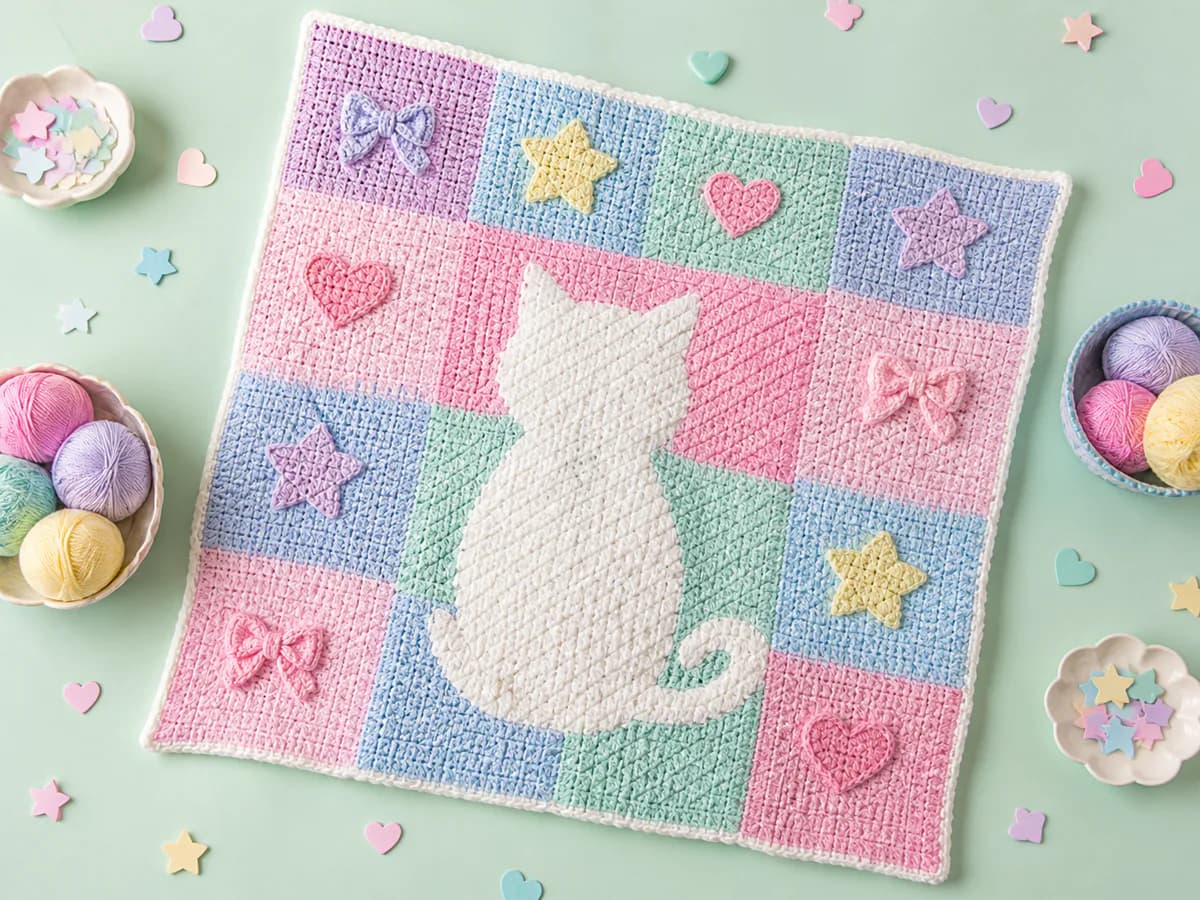
This 25-by-25-block cat-face C2C panel has a complete color chart, a diagonal reading guide, and border instructions. It is an unofficial character-inspired design for personal use, not an official Sanrio pattern.
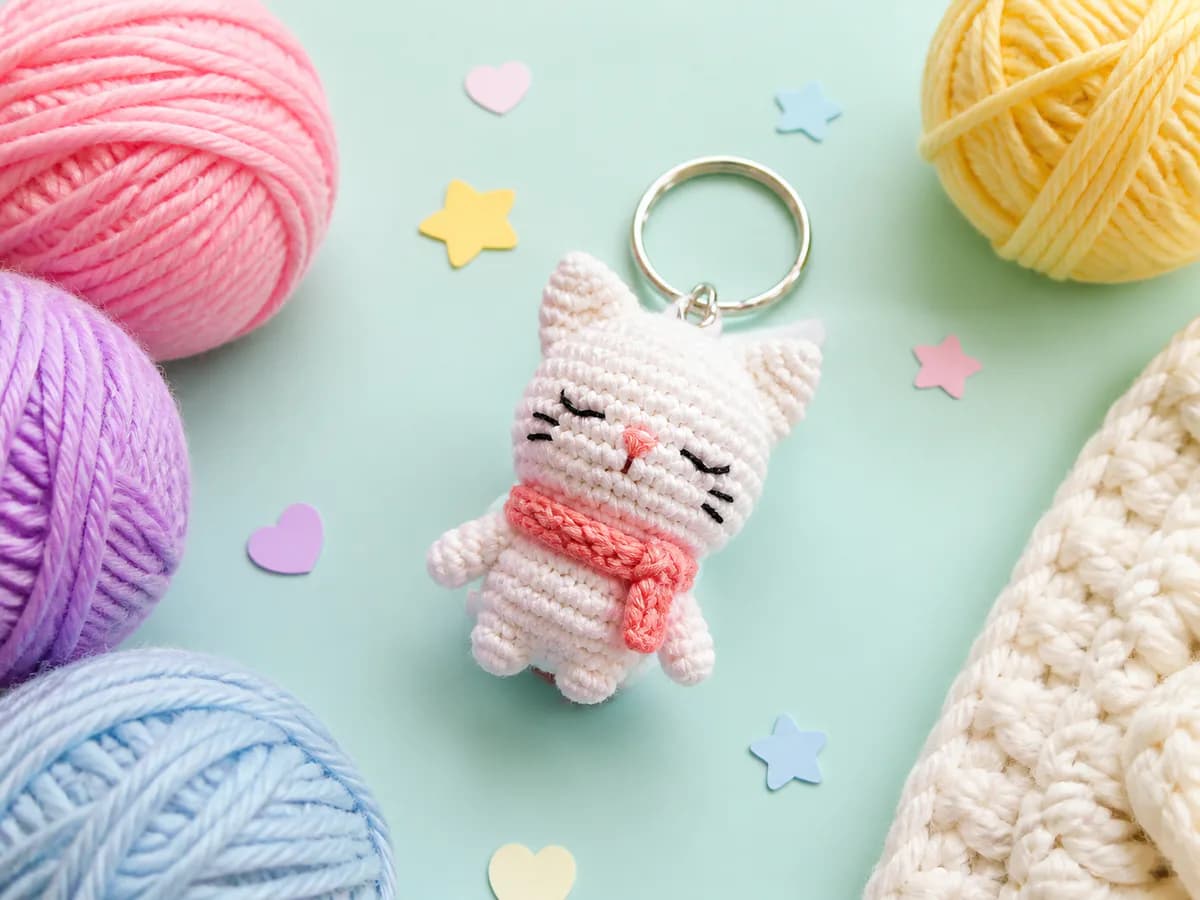
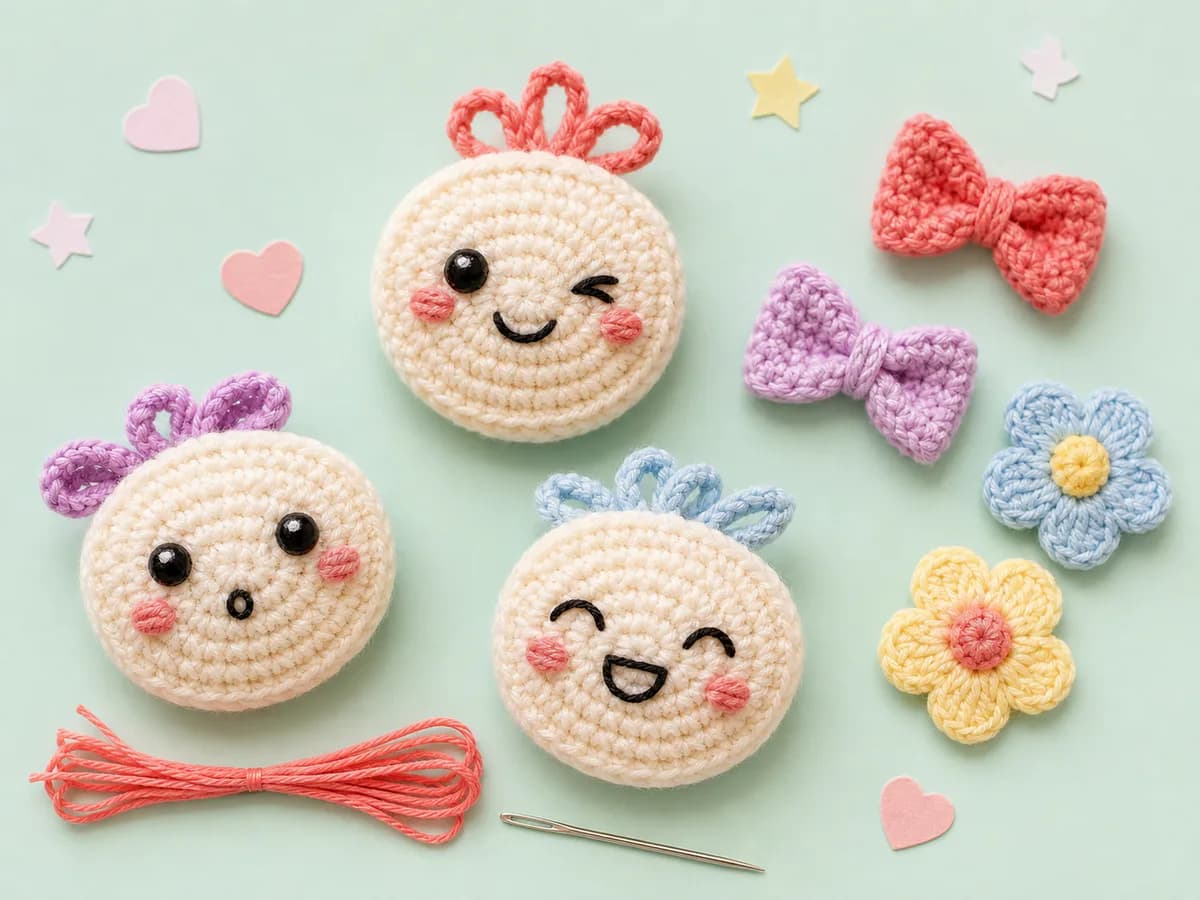
What this makes: a square C2C panel whose size depends on your washed block gauge. It may be a small blanket panel, cushion front, or the center of a larger blanket. A 25-block width does not establish a full-bed-blanket size. The collection image shows hearts, stars, and bows as styling inspiration; the chart below has one cat face and one bow, with no surrounding hearts or stars. The motif and finished size have been checked as a digital chart, not verified against a crocheted sample.
Materials and size plan
- Smooth yarn in background (B), white (W), black (K), yellow (Y), and pink (P); use the same weight and compatible texture across colors
- A hook chosen by a washed C2C swatch: firm blocks with enough drape for your intended use
- Five labeled yarn bobbins or small balls plus extras for disconnected color regions, yarn needle, scissors, and markers
- Optional contrasting yarn for embroidered whiskers after the panel is complete
The chart contains 625 blocks. Its color counts are B 395, W 202, K 4, Y 2, and P 22. These are block counts, not yarn yardage: carrying, tails, tension, and border change yarn use. The bow visually overlays some white face and ear cells, so the chart's color is the final instruction at each position.
Crochet and wash a 5-by-5-block sample with your intended yarn and hook. Measure its dry, relaxed width and height, then divide each by five. Multiply those single-block measures by 25 for the approximate panel width and height, before the border. For example, if a measured five-block span is 10 cm, each block is about 2 cm and the chart would be roughly 50 cm across before its border. Do not use a stitch gauge from a different C2C pattern as if it measured this swatch. If you need a larger blanket, plan the target dimensions and yarn before starting.
Terms and C2C construction
US terms: ch = chain, sl st = slip stitch, dc = double crochet, sc = single crochet, sp = chain space. Each standard block consists of a ch-3 rise and three dc, with the starting ch-3 counted as the first dc of that block. Work the standard double-crochet C2C method, turning after each diagonal crochet row.
- Crochet row 1: ch 6; dc in the fourth chain from the hook and the next two chains. This makes one block at chart column 25, row 1, in the bottom-right corner.
- Crochet rows 2-25 (increase): ch 6 and turn; dc in the fourth chain and next two. Sl st into the ch-3 space of the next block, ch 3, then 3 dc in that same space. Continue joining and making blocks across the diagonal. Each crochet row adds one block, so crochet row 25 contains 25 blocks.
- Crochet rows 26-49 (decrease on both sides): turn, ch 1, sl st across the three dc of the edge block and into its ch-3 space. Ch 3 and work 3 dc in that space. Join and build blocks across as usual, ending with a sl st into the final ch-3 space without building another block there. Each crochet row has one fewer block, ending with one block in row 49. Fasten off.
This decrease method and the bottom-right chart start follow Crochet.com's C2C technique and chart-reading guide. Use its step photos if the slip-stitch travel is unfamiliar. The guide supports the stitch method, not a physical test of our cat motif.
Follow the 25-by-25 color chart
On a phone, open the full-size chart to zoom in or save it while you work.
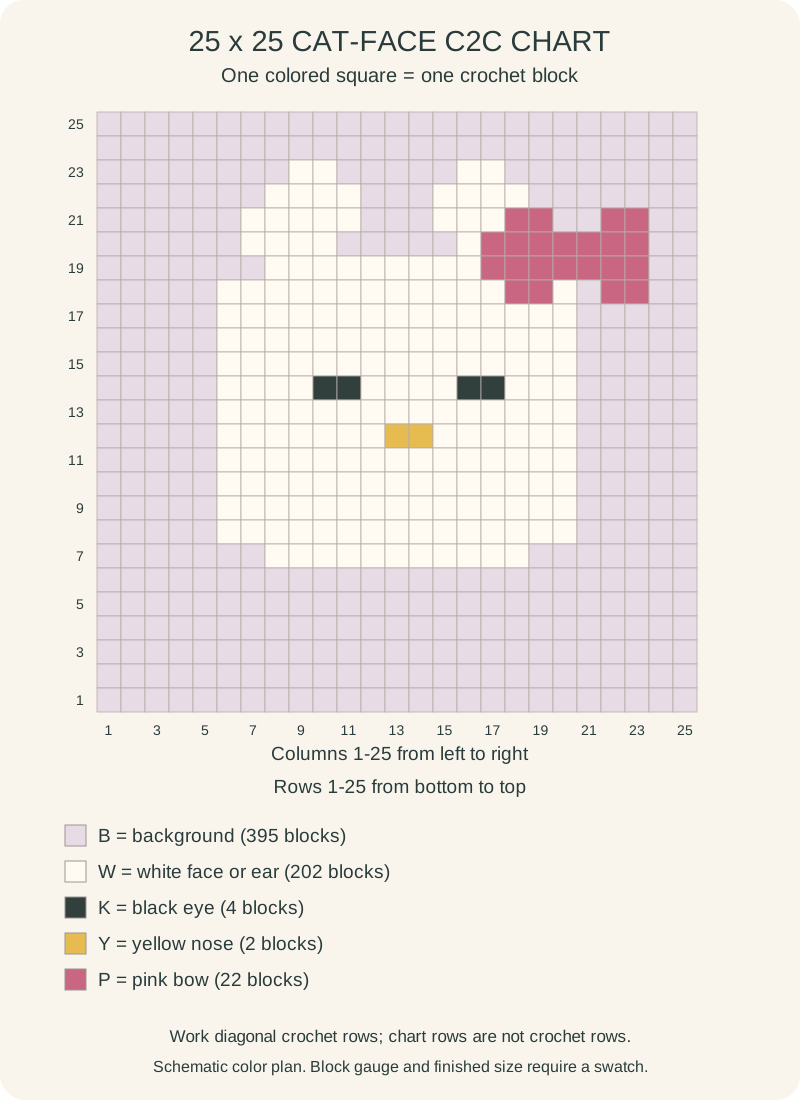
Color key: B = background, W = white, K = black, Y = yellow, P = pink. Follow the displayed square where colors overlap; the chart is the complete plan. Labels show block totals so you can estimate relative color needs, not physical yarn quantities.
A chart row runs horizontally. A crochet row runs diagonally, so do not work all 25 cells of chart row 1 as your first crochet row. Start at the bottom-right B square. The illustration below shows the first five diagonal crochet rows and the coordinates they traverse.
Open the diagonal guide at full size if the coordinate labels are too small on your screen.
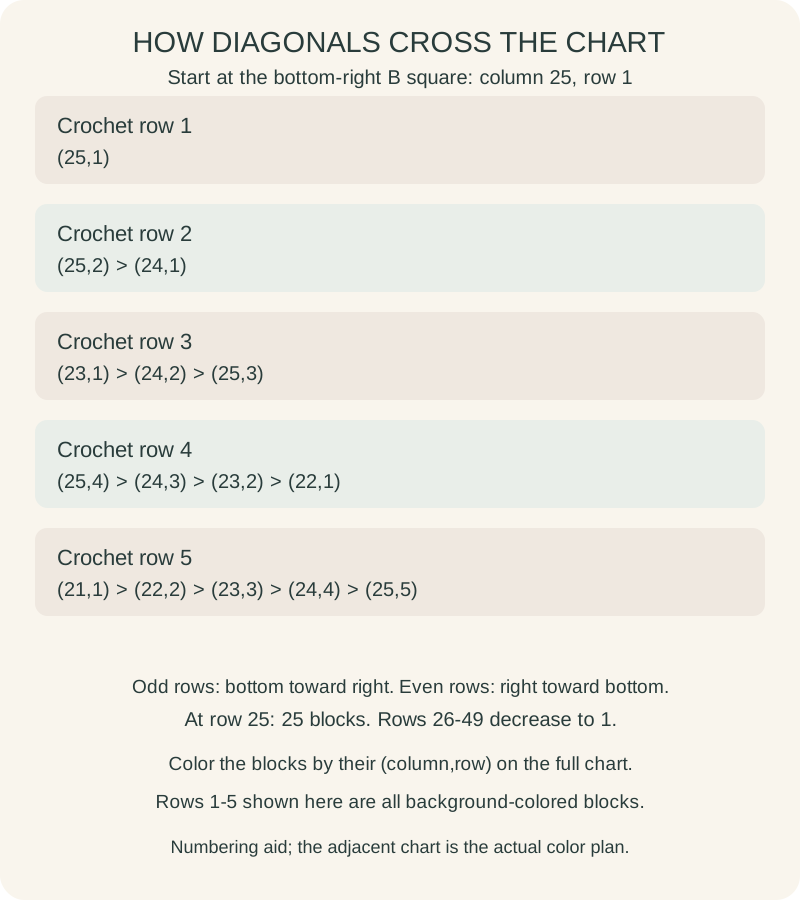
The chart is displayed as you view the front of the finished panel. With this bottom-right starting orientation, odd-numbered crochet rows run from a lower chart position toward the right edge; even-numbered rows reverse. Mark each diagonal on a printout or screenshot before crocheting it. Turned C2C work can make the chart look reversed while its wrong side faces you; compare again from the front before changing the color plan.
Change to the next color at a block boundary. For crisp changes, complete the last pull-through before the new block with the new color. Keep separate bobbins for disconnected regions rather than dragging long floats across the reverse. Crochet.com's graphgan color-change guidance illustrates the method.
Optional whiskers and border
The colored chart has no black whisker blocks; they would be too coarse at this scale. If you want whiskers, use a blunt needle and black yarn to lay three short, separate lines from each cheek on the finished front. Pin temporary guide yarn first so the left and right sides balance. Keep the ends secured on the back without puckering the white face. If the panel will be used around a baby, avoid loose embroidered lengths and have the final item assessed for suitability.
For a simple border, with the front facing, join background yarn and sc evenly around all four sides. Work 3 sc in each corner; on rough block edges, use the spaces and edges as placement guides, not a fixed stitch count that would force cupping. Join to the first sc. Make one more round in the bow color, again using 3 sc in each corner. Block according to your yarn label and remeasure after the border is dry.
Scaling the chart for a larger project
If you enlarge each original square to a 2-by-2 group of C2C blocks, you will create a 50-by-50 graph with 2,500 blocks and 99 diagonal crochet rows. This is a grid enlargement, not simply working each crochet row twice. A doubled grid changes the visual weight of eyes, bow and nose, so inspect the enlarged chart before buying yarn. Your single-block gauge multiplied by 50 estimates the panel size before border; it does not predict a tested blanket dimension or yarn requirement.
Tips & troubleshooting
The motif looks reversed
Check whether you are viewing the front or back of the turned work. The chart represents the finished front. Keep column 25 on the right when looking at the front, and mark the bottom-right starting square before row 1.
One diagonal has the wrong number of blocks
Crochet rows 1-25 should have 1 through 25 blocks; rows 26-49 should have 24 down to 1. Count blocks immediately after a turn. Check whether the edge slip stitches traveled across the previous block before the first new block, or whether you accidentally built a block after the final join.
The bow color spreads into the face
Follow the final pink cells in the chart, not just a verbal rectangle. The bow overlays white positions in the original color plan. Keep individual bobbins nearby and mark the color breaks for that diagonal before starting it.
The panel is smaller than expected
Measure an actual washed five-block sample; a small block multiplied 25 times remains a small panel. Change the yarn and hook or deliberately enlarge the graph to 50-by-50, rather than adding unplanned rows to the finished edge.
Frequently Asked Questions
Is this a full-size blanket?
It is a 25-by-25-block panel. Whether that is a blanket, cushion front, or motif depends on your measured block gauge and intended use. No physical finished size has been verified for this design.
Are the whiskers and face details in the chart?
The eyes, nose, and bow are colored blocks. Only the six optional whiskers are added with a needle after crocheting, because they are too fine for this 25-block-wide pixel scale.
Can I enlarge it by repeating each written crochet row?
No. Expand each chart cell into a 2-by-2 group first, then follow the new 50-by-50 chart diagonally. The enlarged square has 99 crochet rows, not 98 copies of the original row instructions.
Is this an official character pattern?
No. It is an unofficial fan-inspired motif presented for personal use, with no claim of license or endorsement.
Keep exploring
See the kawaii yarn color guide, the cat-face keychain pattern, or the full cat amigurumi pattern. Browse more projects in our crochet pattern library.
Essential crochet guides
Maker notes
Questions or finished-project notes?
Share what helped, ask about a step, or leave a thoughtful note for the next maker.
Loading maker notes...