Crochet Baby Lovey / Security Blanket Pattern
Crochet a textured bear lovey with a gauge-sized square, counted head rounds, embroidered features, attachment guidance, and clear infant-sleep rules.

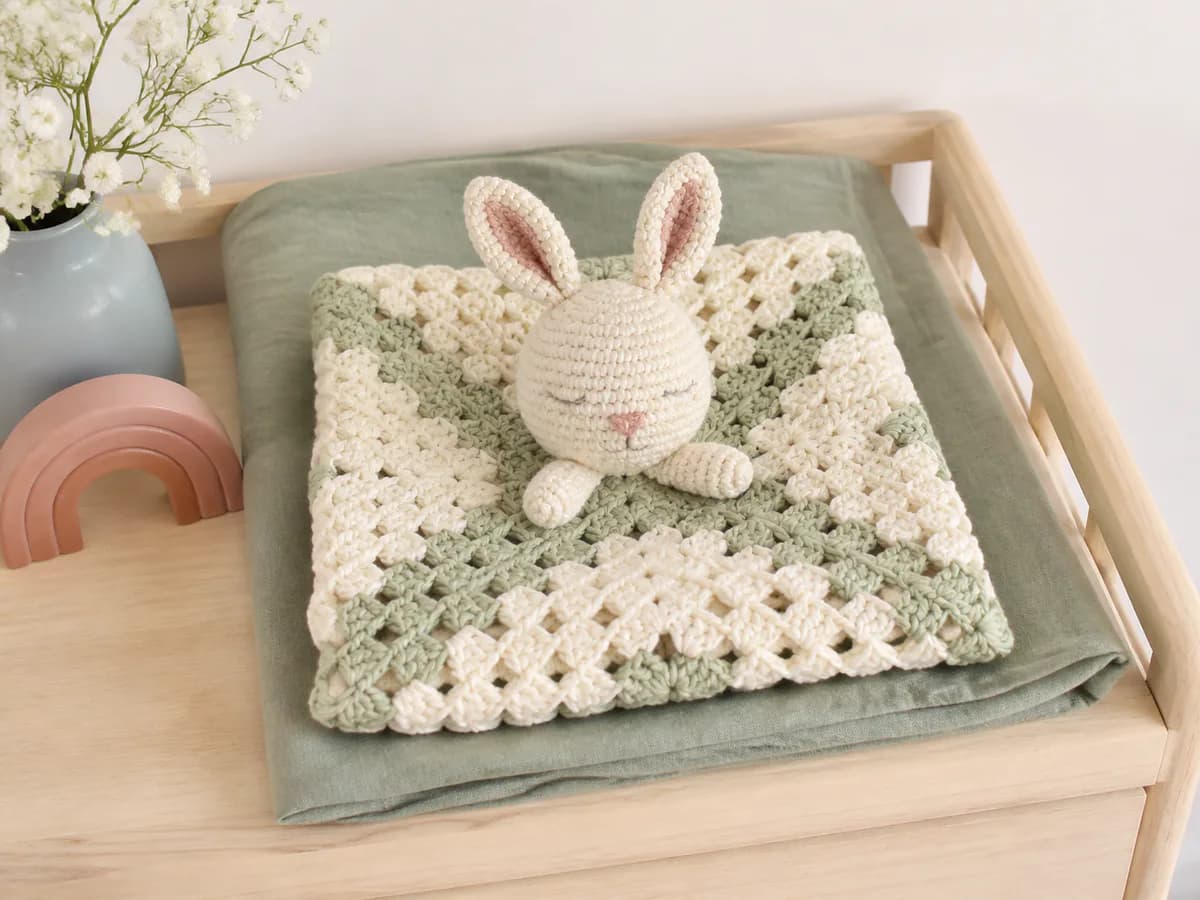
This crochet lovey combines a textured hdc square with a small bear head and embroidered features. The image shows a rabbit-and-granny-square variation; the instructions below make the bear and solid textured square, without the pictured rabbit ears or arms.
Use a lovey only while the child is awake and directly supervised. Keep it out of every infant sleep space, including supervised naps. The NIH safe-sleep guidance explains why loose blankets and soft toys do not belong there.
Materials and supplies
- Machine-washable DK yarn
- 3.5-4.5 mm hook
- Flexible tape measure
- Locking stitch markers
- Yarn needle; embroidered details only for young children
- Washable stuffing for the bear head only
Crochet terms used
The instructions in Crochet Baby Lovey / Security Blanket Pattern use US terms: ch (chain), sl st (slip stitch), sc (single crochet), hdc (half double crochet), dc (double crochet), inc (two stitches in one), and dec (decrease). Counts in parentheses show the stitches expected after that row or round.
Textured lovey square
First make and wash a swatch in the alternating-loop hdc stitch below. Divide the stitches measured over 10 cm by 10 to find stitches per cm. Multiply that value by your chosen square width before the border, round to a nearby odd whole stitch count, and add two chains. For example, 45 stitches measure 30 cm only at 15 stitches per 10 cm; the border adds to that width. This is a gauge calculation, not a fixed finished size.
For the counted 45-stitch example, chain 47. Row 1: Hdc in the third chain and across. (45) Row 2: Ch 2, turn; the chain does not count. Hdc in the first stitch, alternate front-loop hdc and back-loop hdc across the next 43 stitches, then hdc in the last stitch. (45) Repeat row 2, starting the alternating section with front-loop hdc each time, until the piece measures as long as it is wide. Wash and dry it according to the yarn label before checking the final square dimensions.
For border round 1, work 1 sc in each non-corner stitch along the top and foundation edges and distribute sc along both row-end sides so the edge lies flat. Work 3 sc in each corner instead of its single edge stitch; mark the middle sc of each group. Join with a slip stitch. For border round 2, ch 1 (does not count), sc in every non-corner stitch and work (sc, ch 1, sc) in each marked corner stitch. Join and weave in ends. Measure the finished square after drying; do not stretch a rippling border flat to hide excess stitches.
Bear head
Work in continuous rounds: 6 sc in a magic ring (6); inc around (12); repeat (sc, inc) 6 times (18); repeat (2 sc, inc) 6 times (24); repeat (3 sc, inc) 6 times (30); work rounds 6-11 even (30); repeat (3 sc, dec) 6 times (24); repeat (2 sc, dec) 6 times (18). Embroider both eyes and muzzle, stuff firmly, then repeat (sc, dec) 6 times. (12) Leave the lower opening unclosed.
For each ear, work 6 sc in a magic ring (6), then inc around (12). Fasten off, fold the circle in half, and sew its lower edges together to make a semicircle. Sew ears across head rounds 4-6. Center the open 12-stitch neck on the square and sew it through the blanket center with two complete passes plus a second hidden reinforcement circle. Use dense fabric that contains all stuffing, reinforce the neck through full blanket stitches rather than gaps, and inspect every seam after washing and before use. Stop using the lovey if a seam loosens or stuffing becomes accessible. These checks do not make a lovey appropriate for infant sleep.
Tips & troubleshooting
Why is my square a different size?
The 45-stitch example is a count, not a guarantee of 30 cm. Recheck your washed stitch gauge, measure before and after the border, and adjust the odd foundation count before making the full square. Changing only the hook without remeasuring changes both fabric density and size.
What if the border ripples or cups?
Ripples usually mean too many stitches along the row ends; cupping can mean too few or an overly tight border. Undo the affected edge and redistribute the stitches evenly. Keep the four corners marked so their increases stay in place.
How should the head be attached?
Center and pin the open neck before sewing. Catch each neck stitch and a secure blanket stitch, reinforce the attachment, and bury the ends. Do not attach through a single strand or rely on glue. If the blanket stretches into large gaps at the attachment, use a denser fabric rather than adding more stuffing.
Frequently Asked Questions
Is this the rabbit shown in the image?
No. The written project uses round bear ears and a textured hdc square. The pictured rabbit and granny-square fabric are a different variation; their ears, arms, and square are not instructions in this pattern.
Can a baby sleep with this lovey?
No. Keep loose loveys, blankets, and stuffed toys out of an infant's sleep area, even during a supervised nap. Reserve this project for awake, directly supervised interaction and remove it before sleep.
How much yarn is needed?
Weigh a washed square swatch and scale its weight to your planned blanket area for a starting estimate. The head, ears, border, and attachment need additional yarn. Their quantity depends on yarn and tension, so do not treat the square estimate as the total project requirement.
Can I change the square size?
Yes: use your washed gauge to calculate an odd number of stitches, then add two foundation chains and work until square. Increasing the blanket size also changes its weight and the stress on the head attachment; it does not change the infant-sleep restriction.
Keep exploring
For a wearable gift instead of a comfort object, see the baby cardigan construction and sizing notes. For fabric choices and other projects, continue with Baby and Kids Crochet Patterns and Safety Guides, Crochet Toy Safety Guide and Beginner Pattern, Crochet Baby Booties and Hat Set (Free Pattern). For a broader route through the site, use the Ultimate Free Crochet Pattern Library.
Essential crochet guides
Maker notes
Questions or finished-project notes?
Share what helped, ask about a step, or leave a thoughtful note for the next maker.
Loading maker notes...